No family has lost so many battles, botched so many machines or kept a recipe for so long. The Kybourgs are poor warriors, reckless inventors and excellent brewers.
Chapter I · 1200 – 1570
The golden age of defeat
Settled on the Swiss Plateau since the 10th century, the Kybourg family is one of the great dynasties that shaped Switzerland's destiny in the Middle Ages. Historians agree that without it, Switzerland would have taken shape considerably faster.
Learned and passionate, the Kybourgs speak Latin, read the stars and draw machines of breathtaking audacity. They also build them, which is more regrettable. The family motto, Semper ad astra, was carved above the castle gate at the third attempt: the first two were blown away by catapult trials.
Brave and visionary, they have sharp minds but no sense of strategy whatsoever. People still talk about the assault of 1227, led with admirable courage against a perfectly impregnable castle: their own.
There is one thing, however, the Kybourgs have never got wrong: the beer.
The Kybourgs were people of striking beauty.
1241
Bouchard's siege tower
Bouchard de Kybourg (1203 – 1258) designs a siege tower of unprecedented height. So tall, in fact, that it no longer fits through the gate of the courtyard where it was built. There it stays.
His troops, deprived of a battle but generously supplied with the family ale, go home in excellent spirits. Bouchard considers the affair a success.
1264
Laying down arms
A long period of hostilities pits the Kybourgs against the Habsburgs. The Kybourgs invent sophisticated war machines but neglect, for instance, to think about feeding an army. Being passionate brewers, however, they never skimp on the beer for their troops.
Defeated by the Habsburgs, they lay down their arms and enter a period of serenity, which they put to good use doing what they do best: aiming for the skies, and brewing beer.
1389
Aymon the Prudent
Aymon de Kybourg develops a helmet with a fixed visor that protects the face admirably but lets you see nothing. He never takes it off again and spends most of his time in the brewery, the only place he can find with his eyes closed.
We owe him the first beer recipe ever written down in the family archives. It is, by common consent, remarkable.
1400 – 1570
Retreat to the monastery
Tired of defeats and exploding machines, all the men of the family take holy orders and retire to the abbey. No more inventions: the Kybourgs take vows of silence, poverty and chastity, and devote themselves body and soul to the monks' brewery.
For nearly two centuries, the recipes are faithfully handed down from father to son. On this particular point, the abbey's records remain exemplarily discreet.
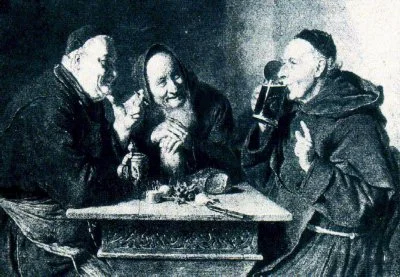
The Kybourg brothers at the abbey brewery. Note a certain family resemblance.
Chapter II · 1570 – 1894
Philibert's heirs
1612
Philibert reaches for the stars
Breaking with two centuries of monastic wisdom, Philibert de Kybourg (1574 – 1612) revives the family tradition. He is the first to try to touch the stars, recycling gunpowder into propulsion rockets. Reckless but visionary, he ties forty rockets to a wooden armchair. Wearing a padded helmet and a leather shell fitted with jointed wings, he orders his footmen to light all the little fuses at once and send him off to infinity.
He eventually goes beyond: behind the cloud of smoke, Philibert is well and truly gone for good. To honour this pioneer, his brother Oudin, his partner in invention, creates a sparkling blond beer in the image of the dear departed.
Though Philibert died young, barely 38, he still found time to father six children, most of whom got over the trauma of their father's death to carry on his research.
The people struggled to get over Philibert de Kybourg's disappearance.
1688
Anselme and the canvas wings
Philibert's grandson, Anselme de Kybourg, leaps from the top of St Nicholas tower in Fribourg wearing waxed-canvas wings of his own design. He glides with a grace every witness praises, all the way into the Sarine river, where a family of tanners, busy rinsing their hides, hauls him onto the bank.
He maintained to the end of his days that this was exactly what he had intended.
1784
The wort balloon
Barely a year after the Montgolfier brothers, Théodule de Kybourg launches a balloon filled with brewing steam. The craft rises a good two metres, hesitates, then drops back into the vat.
That year's slightly smoky beer went down in history as the best of the century.
1894
Octave, or the lull
Octave de Kybourg is the only member of the line who never invented anything. Under his rule, the family enjoys an unprecedented period of calm and prosperity, and the brewery runs at full capacity.
Fate, however, is watching. On the night of 31 December 1894, his eldest son Honoré is born in Fribourg. The fairies of adventure lean over his cradle. A few years later comes Adalbert, who prefers to lean over the brewing vats.
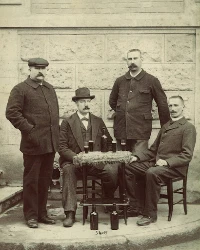
Overjoyed, Octave de Kybourg (second from left) has just heard of the birth of his son Honoré.
Chapter III · 1894 – …
Honoré de Kybourg
A worthy heir to Philibert's courage, Honoré excels at the Jesuit college of St Michael in Fribourg, where he nurtures a passion for ornithology. Fascinated by the flight of birds, he dreams of feeling the thrill of altitude and starts designing flying machines. Then rolling ones. Then floating ones.
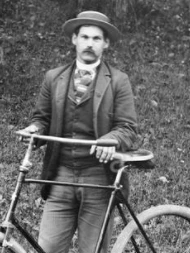
Honoré, shortly before turning his bicycle into a velicopter. The bicycle never recovered.
His younger brother Adalbert, a great admirer of his elder, adopts the same philosophy and constantly improves his brewing techniques. For each of Honoré's exploits, he brews a beer to celebrate it. Or to console him.
20years
The flying paddle
Honoré dreams of flying like the birds. His first flight, aptly named "the flying paddle", is a first in more ways than one: he breaks half a dozen ribs.
Adalbert brews a heavily hopped, refreshing blond IPA with citrus flavours.
25years
The submarine egg
His abrupt encounters with the ground lead Honoré to explore the deep. One choppy day the cabin breaks apart and floods. Pulled from his nutshell just in time, Honoré swears never to drink water again.
To help him keep his word, Adalbert brews a powerful triple stout with intense roasted malt flavours.
30years
The velicopter
A late convert to cycling, Honoré puts his love of the bicycle to the service of flight. He crashes onto a barn roof, breaks both shins and gives up pedalling on the spot.
To mark the end of this cycle, Adalbert creates an amber beer, as rich as it is light.
33years
The gauze compress
Between exploits, Honoré is a devoted visitor to hospitals, contributing significantly to the development of orthopaedics and reconstructive medicine.
Adalbert dedicates a fresh, intense wheat beer to him, with subtle notes of wheat and orange.
38years
The vapositoire
A keen astronomer, Honoré combines a steam boiler with the aerodynamics of a torpedo. The machine vanishes forever into the crater of its landing. Honoré is found, slightly confused, near Basel.
To bring everyone back together, Adalbert brews a smooth, thirst-quenching blond.
To be continued
The next exploit
Honoré is working on a new machine. The details are being kept secret, which, in the family's view, is probably for the best.
Adalbert, just in case, has already started brewing: a straw-blond pilsner, the family's first bottom-fermented beer.
Today
The tradition lives on in St. Antoni
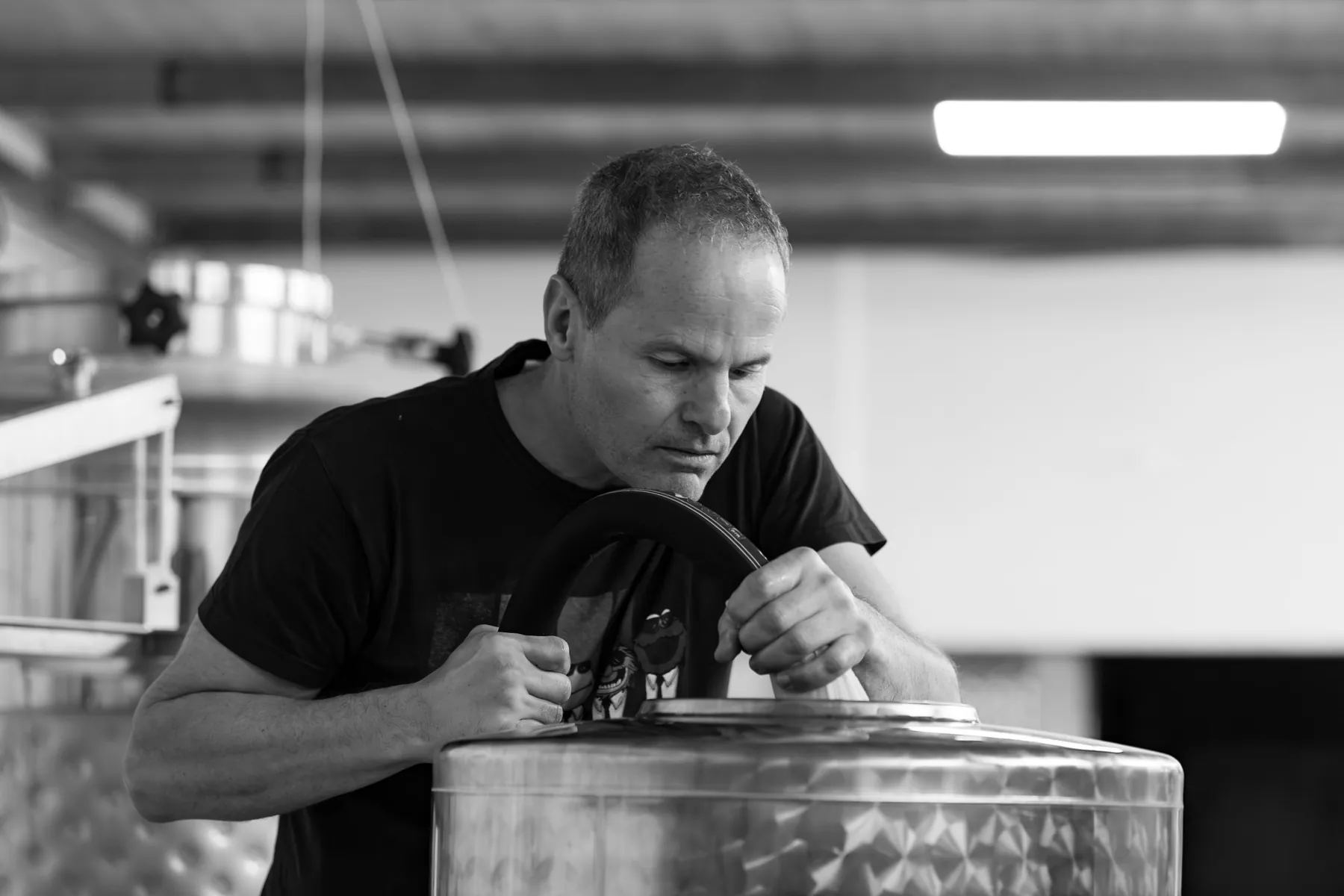
For some fifteen years, Alain Macheret has brewed Bières des Kybourg in a former distillery in St. Antoni, scrupulously respecting family tradition. To date, he has invented no machines whatsoever.